

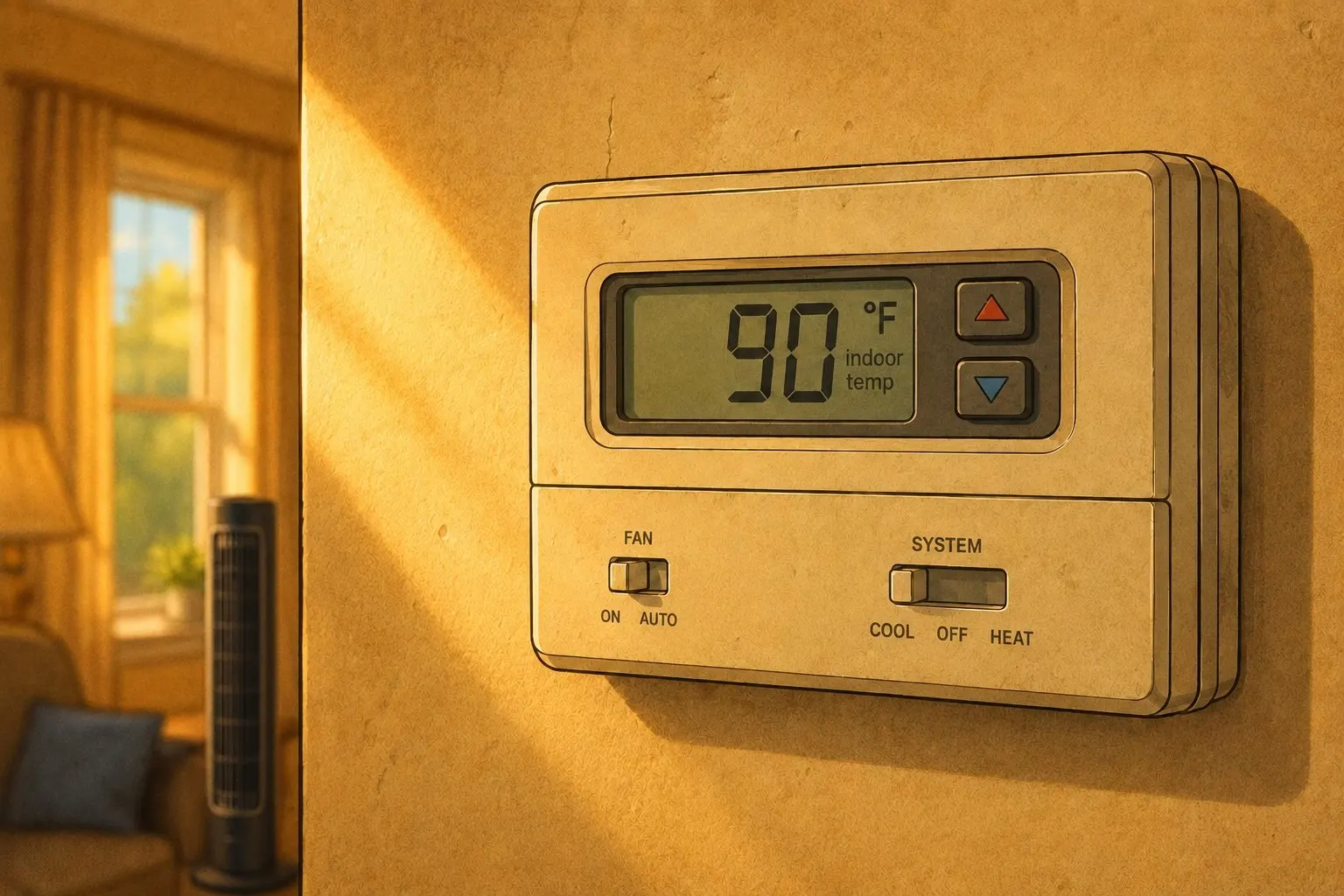
If you’ve lived in Placerville long enough, you know exactly how it goes. By two in the afternoon, the upstairs bedrooms are stuffy and close, and the air conditioner seems to be running without actually winning. Then, somewhere around nine at night, you’re reaching for a blanket because the temperature has dropped forty degrees since sundown. The system is running. It just isn’t keeping up.
This isn’t purely a maintenance problem, though maintenance matters. It’s a climate problem. Placerville sits in one of California’s most thermally demanding environments, and most HVAC (heating, ventilation, and air conditioning) systems were never designed with that reality in mind.
Placerville’s Climate Is Unlike Anywhere Else in California
What Placerville’s Temperature Extremes Mean for Your Home
Placerville sits at roughly 1,800 feet in the Sierra Nevada foothills of El Dorado County. That elevation creates one of California’s most dramatic diurnal temperature ranges, meaning the gap between a day’s high and its overnight low. In summer, afternoon highs regularly push past 95 to 102 degrees Fahrenheit, while overnight lows frequently settle into the low to mid 50s. That’s a daily swing of 40 to 50 degrees in summer alone. Stretch that across the full calendar year and the picture gets more demanding: winter lows in Placerville can dip into the 20s, which means the range from a peak summer afternoon to a cold winter night spans close to 80 degrees.
Valley communities like Sacramento don’t experience this the same way. Nights in the valley stay warm, so cooling systems work against a relatively steady baseline. In Placerville, your HVAC system has to handle the full range of both extremes within the same 24-hour period, cooling hard through the heat of the afternoon and then sitting largely idle as temperatures tumble after sunset. That cycle puts a very different kind of stress on equipment than what manufacturers typically design for.
Why Foothill Elevation Changes the Rules for HVAC
Elevation also affects air density, humidity behavior, and how efficiently a system can move conditioned air through a home. Systems specified for standard California conditions at lower elevations may underperform here in ways that never get flagged during a routine service call.
Local environmental factors add another layer of stress that most installer specs don’t account for:
- Pine pollen and oak debris that clog filters faster than in valley or coastal climates
- Seasonal wildfire smoke that pushes air quality and filtration to their limits
- Wood stove use in winter that adds particulate load to indoor air
Each of these shortens maintenance intervals and puts additional strain on equipment that’s already working hard against the daily temperature swing.
Why Most HVAC Systems Struggle With Extreme Temperature Swings
The Sizing Problem Nobody Talks About
One of the most consistent issues in Placerville homes is equipment that was sized for peak cooling demand but not for the full range of conditions the home actually experiences through a calendar year. A system sized to handle 100-degree afternoons will run near its maximum capacity through summer days, then spend summer nights cycling on and off at very low output as temperatures drop into the 50s. That uneven workload, hard all day and then barely working at night, creates disproportionate wear and rarely delivers consistent comfort.
Proper system sizing for a foothill home requires accounting for both the high end and the low end of the temperature range, not just the worst afternoon of August.
Single-Zone Systems and Their Limitations in the Foothills
Most older homes in the Placerville area run on a single-zone central system: one thermostat, one temperature setting for the whole house. The problem is that heat rises, sun exposure varies significantly from room to room, and Placerville’s climate amplifies every imbalance. A south-facing room can run 10 to 15 degrees warmer than a north-facing bedroom on the same afternoon. A single thermostat placed in a central hallway has no way to detect or compensate for those differences.
The result is a home where some rooms are comfortable, some are too hot, and some stay inexplicably cold, regardless of where the thermostat is set.
How Ductwork Amplifies the Problem
Older duct systems, common in homes built before the 1990s, were not designed with energy efficiency or zoning in mind. Ducts that pass through unconditioned attic space absorb significant heat in summer and lose heat quickly in winter.
In a climate with as wide a daily range as Placerville’s, those duct losses are not a minor inefficiency. They are a constant drain on system performance that makes every other problem worse.
The U.S. Department of Energy estimates typical duct losses can reach 20 to 30 percent in homes with ducts in unconditioned spaces. If a significant portion of conditioned air is losing temperature before it reaches the living space, no amount of thermostat adjustment is going to solve the underlying discomfort.
Signs Your HVAC System Is Losing the Battle Against the Swing
Not every struggling HVAC system announces itself with a breakdown. More often, the signs show up as a slow, steady frustration that homeowners chalk up to “just how it is” in the foothills. If any of these sound familiar, it may be time for a closer look at how your HVAC handles Placerville’s full seasonal range. The most common indicators that your system is not matched to Placerville’s climate include:
- The AC runs for hours without reaching the thermostat set point on summer afternoons
- Different rooms feel noticeably hotter or colder than others, regardless of thermostat settings
- Energy bills are higher than expected relative to the comfort you’re actually getting
- The home takes until mid-morning to cool down after a hot night, even when the AC ran through the evening
It Runs Constantly but Never Quite Catches Up
If your air conditioner runs for long stretches during afternoon hours without the home reaching your set temperature, the system is either undersized for peak demand, losing too much air through the ductwork, or both. A healthy, well-matched system should be able to maintain the set temperature even during the hottest part of the day, not just catch up briefly and then fall behind again.
This pattern of running constantly without winning is one of the clearest signals that the current setup is not matched to your home and your local climate.
Different Rooms Feel Different Temperatures
Consistent temperature variation across rooms, especially between floors or between sun-facing and shade-facing spaces, is a sign that the current system is not matched to your home’s layout. In Placerville, where the temperature swings create uneven pressure on different parts of the house throughout the day, this problem tends to be more pronounced than in flatter, more temperate climates. It is not something that gets better on its own, and it is not something homeowners should have to live with indefinitely.
What Actually Works in Placerville’s Climate
Right-Sized Equipment Matched to Foothill Conditions
Getting the sizing right starts with a load calculation, a detailed engineering assessment that accounts for the home’s actual square footage, insulation quality, window orientation and exposure, and the specific temperature range for the Placerville area. This calculation should not be estimated or carried over from a previous system without review. A system sized for valley conditions will not perform the same way at 1,800 feet across Placerville’s full seasonal temperature range. The inputs matter, and a thorough assessment is the only reliable way to get them right.
Ductless Mini-Splits as a Zoning Solution
For many Placerville homeowners, the most effective solution to the hot-days, cold-nights problem is zone-controlled heating and cooling. Jonas’s installation team specializes in Mitsubishi ductless systems and holds Mitsubishi Diamond Contractor status, meaning technicians are factory-trained and held to manufacturer quality standards. Ductless mini-split systems let you set independent temperatures in specific rooms or areas, which means an upstairs bedroom can stay cool while the downstairs living area is already comfortable for the evening.

You’re also not conditioning empty spaces unnecessarily, which makes a real difference on energy bills when the house is only partially occupied during the day.
For homes where extending or replacing ductwork is impractical or cost-prohibitive, ductless systems offer a flexible and highly efficient alternative. If you have been dealing with uneven temperatures for years, it is worth understanding how ductless systems are designed to handle the specific temperature demands of a foothill home.
Heat Pumps Built for Wide Temperature Ranges
Modern heat pumps have improved significantly over the past decade, and Placerville’s cool nights actually make them more efficient than they are in valley climates. Because heat pumps move heat rather than generating it, they perform well in environments where overnight temperatures stay moderate even in summer, as they typically do in the foothills.
A well-matched heat pump can deliver efficient heating through Placerville winters and effective cooling through summer without the energy draw of a conventional system running at maximum capacity every afternoon.
The U.S. Department of Energy notes that heat pumps can reduce electricity use for heating by roughly 50 percent compared to electric resistance heating, and cold-climate models continue to improve their effective operating range. Understanding how a heat pump performs specifically in foothill conditions is a good starting point for any homeowner weighing a system replacement.
The Role of Routine Maintenance in an Extreme Climate
Tune-Ups Before Peak Season Matter More Here
Because Placerville HVAC systems cycle through such a wide daily range of demands, the wear they accumulate over a season is proportionally higher than systems in more moderate climates. A tune-up that catches a slightly low refrigerant charge, a partially blocked coil, or a worn capacitor in April can prevent a complete breakdown in the middle of a 100-degree July afternoon. In a foothill climate, preventive maintenance is not optional. Staying ahead of that wear with a structured HVAC maintenance plan is one of the most reliable ways to extend equipment life, reduce repair costs, and maintain consistent comfort through both summer and winter.
What a Professional Assessment Reveals
A professional assessment does more than confirm whether the system is running. For a Placerville home, a thorough evaluation typically covers:
- How well the system is sized for the home’s square footage, layout, and local temperature range
- Duct condition and how much conditioned air is being lost through attic or crawlspace runs
- Refrigerant charge, coil condition, and component wear that affects peak-day performance
- Whether the current setup can realistically handle the foothill climate’s daily demands
For homeowners who have been living with the hot-days, cold-nights pattern for years, an assessment often identifies a specific and solvable cause rather than confirming that foothill discomfort is unavoidable. Knowing the root cause is the first step toward actually fixing it.
How Jonas Energy Solutions Approaches Placerville HVAC
Local Experience With Local Conditions
Jonas Energy Solutions is a family-owned company with roots going back to 1935, and the team now serving Placerville and El Dorado County brings that same depth of hands-on HVAC experience to the foothills. That experience includes understanding how the foothills’ temperature swings affect equipment performance, how older homes in the area are typically built, and what solutions have actually held up over time in this climate. That kind of local context is not something you can get from a contractor whose experience is primarily in the valley or on the coast.
Getting Your Home Assessed
If your home runs hot through the afternoon and cold by evening, and your system seems to be working but never quite solves the problem, it is worth getting a professional opinion before the next summer peak arrives. Contact Jonas Energy Solutions or give us a call to schedule an assessment. It’s a straightforward conversation about your home, your comfort, and whether your current setup is the right fit for where you live.