
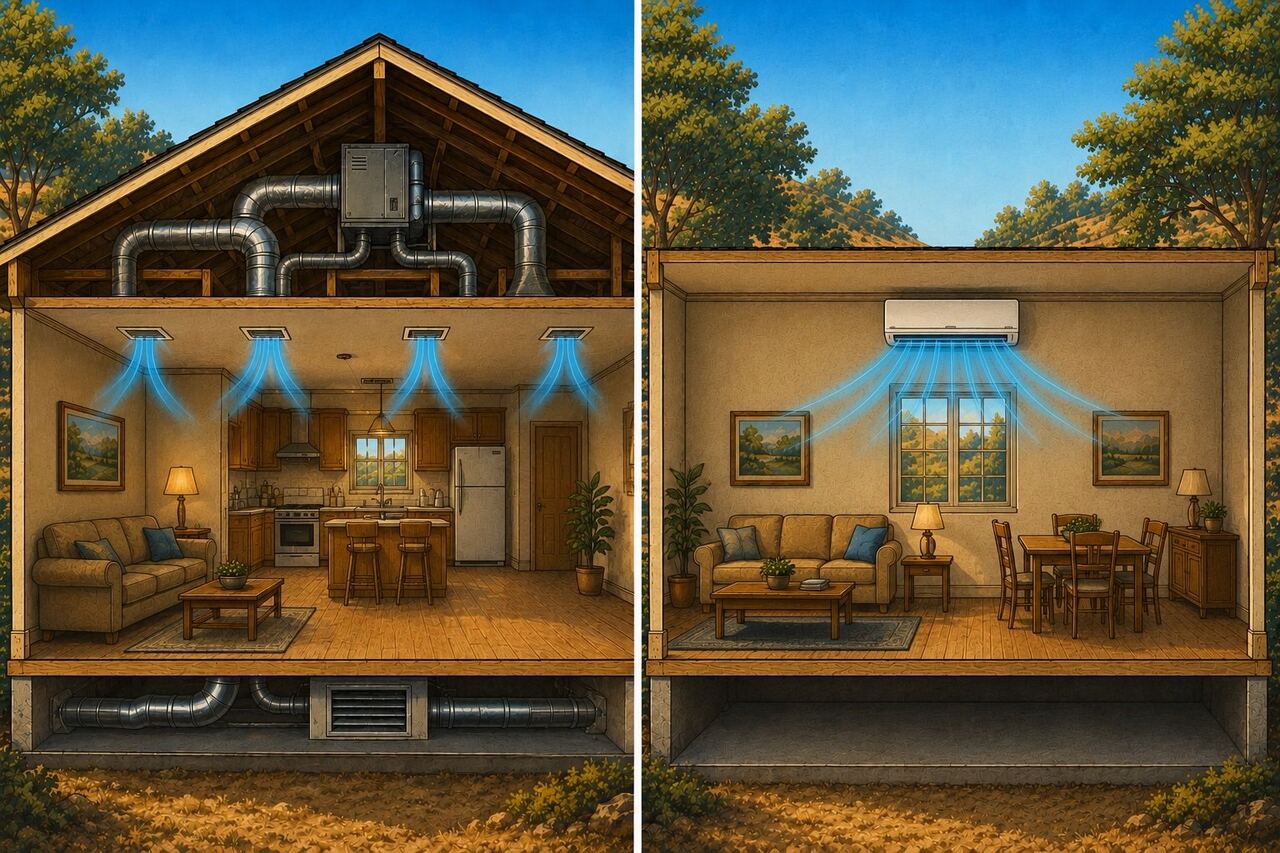
If you live in Lake County, you do not need a reminder that summer heat can get intense. When the forecast starts flirting with triple digits, the question many homeowners ask is not just “How do I cool the house today?” It is “What upgrade will keep us comfortable for the next 10 to 20 years?”
For older homes, the mini split vs central air decision usually comes down to ductwork, layout, and how you use each room day-to-day. Both can work great. Both can also disappoint if they are mismatched to the home, the ductwork, and the way your household actually uses each room.
Below is a practical, homeowner-friendly guide to help you decide which system makes sense, what really drives costs, and how to get an estimate that answers the right questions.

Mini-split vs central AC: the quick Lake County decision framework
If you want a fast way to start, use this rule of thumb: mini-splits shine when you want targeted comfort and flexibility, while central AC shines when your ductwork and layout support whole-home airflow.
When a mini-split is usually the better fit
A ductless mini-split is often the best choice when:
- Your home has older, leaky, or undersized ductwork, or no ductwork at all.
- You have rooms that are always hotter or colder, and you want room-by-room control.
- You want to cool the house efficiently without paying to condition unused rooms.
- You are remodeling, converting a garage, or adding a space where extending ducts would be expensive.
Mini-splits are also a strong fit for many Lake County households because they can deliver steady comfort during heat waves without relying on ductwork that was never designed for today’s temperature swings or insulation standards.
When central AC is usually the better fit
Central AC is often the better choice when:
- Your home already has good ductwork that is properly sized and in decent shape.
- You want a single system that cools the whole house with a consistent feel.
- You prefer the look of vents over wall-mounted indoor units (or you want ducted mini-split options, which can sometimes split the difference).
- You want the simplest user experience: one thermostat, one set of filters, one primary system to maintain.
The most common “tie breaker” factors we see locally
If you are stuck between the two, these factors usually decide it. First, ductwork condition and layout tends to be the biggest swing factor. Next, think about how many rooms you truly need cooled all day versus only at certain times. Then consider electrical capacity and whether new circuits or panel work will be required. Finally, be honest about your tolerance for visible indoor units versus vents.
The key is not picking the trend. The key is picking the system that matches your home.
Comfort and performance in older Lake County homes
Older homes can be charming. They can also be challenging from an HVAC perspective. High ceilings, additions from different decades, crawlspaces, older insulation, and long duct runs can all affect how a system performs.
Ductwork realities: leaks, sizing, and hot spots
Central AC depends on ducts. If the ductwork is leaky, crushed, disconnected, or undersized, the system can struggle even if the equipment is brand new. In that situation, it is common to see hot bedrooms in the late afternoon, a living room that never quite cools down, a system that runs constantly but still feels behind, and higher bills without better comfort.
In many older Lake County homes, the duct system was designed for a different era of heating and cooling loads. That is why a “simple equipment swap” is not always the best plan.
Zoning: cooling the rooms you actually use
One of the biggest real-world benefits of mini-splits is zoning. If you spend your days in the home office and your evenings in the living room, you can focus cooling where you are.
For example, in a two-story Lakeport home where upstairs bedrooms run hot after 3 PM, a zoned approach can keep sleeping areas comfortable without overcooling the downstairs all afternoon.
That matters during heat waves when you want reliable comfort without feeling like you have to cool the entire home at full blast all day.
Noise, airflow, and day-to-day feel
Comfort is not just temperature. It is also air movement (drafty versus gentle), sound (a loud blower or duct noise versus quieter operation), and consistency (big temperature swings versus steady control).
Mini-splits often feel steady because they can modulate output. Central systems can feel great too, especially when ductwork and airflow are dialed in. The best outcome is always a well-designed system, not a specific technology.
Total cost, operating costs, and what homeowners miss in comparisons
When people compare costs, it is easy to focus only on the equipment. The reality is that installation scope can matter just as much.
Installed cost: what drives pricing up or down
The installed price is usually driven by a handful of variables: the number of zones and indoor unit types (for mini-splits), whether ductwork repair or replacement is needed (for central AC), any required electrical upgrades (panel capacity or new circuits), access challenges (tight attic, crawlspace issues, roofline complexity), and permitting and code requirements.
If you want a fair comparison, ask contractors to explain what is included and what is not. A cheaper quote can become expensive if it leaves out duct repairs, electrical work, or proper commissioning.
Utility bills: efficiency, run time, and right-sizing
Efficiency matters, but right-sizing matters more than most people think. A system that is too large may short-cycle, which can reduce comfort and humidity control and put extra wear on components. A system that is too small may run nonstop and still fall behind during the hottest days.
The best approach is to size the system to the home and your comfort goals, then set realistic expectations for peak days.
For a neutral overview of how heat pumps and high-efficiency HVAC systems work (and why sizing matters), the U.S. Department of Energy has a solid explainer.
Maintenance and long-term reliability expectations
Both system types need maintenance. In general, central AC often means staying on top of filters, coils, and duct checks, while mini-splits often mean regular filter cleaning, coil care, and keeping outdoor units clear.
Either way, consistent maintenance is one of the simplest ways to protect your investment, reduce breakdown risk, and keep performance steady.

Installation and timeline: what to expect during peak season
During Lake County’s hottest stretches, HVAC schedules can fill quickly. Planning early helps you avoid rushed decisions.
Mini-split install: typical scope and timing
Many mini-split projects can be completed quickly, especially if there is good access and the scope is straightforward. A typical path is confirming the rooms to condition and the load needs, selecting indoor unit locations that make sense for airflow and appearance, running refrigerant lines and electrical, and then commissioning the system so it performs as intended.
Central AC install: typical scope and timing
Central AC projects can be simple or complex depending on ductwork. Typical steps include confirming duct condition and airflow needs, selecting equipment and verifying sizing, installing or upgrading the system components, then testing airflow and verifying performance.
Permits, electrical, and avoiding surprise change orders
The best way to avoid surprises is to make sure your estimate answers these questions up front: whether ductwork repair or replacement is recommended, whether the electrical panel will support the new load, whether permits are required and who is handling them, and what the plan is for commissioning and performance testing.
Clear answers up front lead to smoother installs and fewer last-minute change orders.
How to choose the right system for your home (and avoid buyer’s remorse)
If you want the decision to feel obvious, focus on your house and your habits, not just specs.
A simple checklist to bring to an estimate
Before you request an estimate, get clear on a few things: which rooms are hardest to keep comfortable today, whether there are rooms you rarely use during the day, whether you have existing ductwork and if it has been evaluated recently, whether you prefer whole-home consistency or targeted zones, and whether aesthetics matter more to you (vents versus indoor units).
In a good in-home evaluation, you should expect the contractor to look at airflow and duct condition (if you have ducts), confirm electrical capacity, and size the system to the home rather than swapping equipment “like for like.”
Questions to ask any contractor (mini-split or central)
Ask these questions before you sign:
- How are you sizing the system for my home?
- What ductwork issues (if any) will prevent good performance?
- What is included in the quote and what could change later?
- What does maintenance look like after installation?
- What should I expect during a 100°+ heat wave?
Financing and next steps
If you are comparing options, the next step is a clear, apples-to-apples estimate. If monthly payments are part of the decision, review Jonas Energy’s financing information before you commit to a system type.
When you are ready, request an estimate and get a plan tailored to your home’s layout, ductwork condition, and comfort goals. You can also browse recent HVAC and energy content ideas in their blog to see what local homeowners are asking about.