When the power goes out in Lake County, it is rarely just an inconvenience. Between Public Safety Power Shutoffs, wildfire season, and the region’s distance from major grid infrastructure, outages here tend to run longer and hit harder than they do in more urban parts of California. For homeowners who have already sat through a multi-day shutoff, the question is not whether to invest in backup power. The question is: home battery vs generator, which one suits your situation best?
Home batteries and whole-home generators are both real, proven solutions. They are not interchangeable, though.
The right choice depends on how you use your home, how long outages typically last in your part of Lake County, whether you already have solar, and what you are most trying to protect. Jonas Energy has been installing both systems in Lake County since 2000, and what follows is a plain-language breakdown of how each option actually works, where each one falls short, and how to think through the decision for your specific situation.

Why Backup Power Is No Longer Optional in Lake County
The Reality of PG&E PSPS Shutoffs in Lake County
PG&E’s Public Safety Power Shutoff (PSPS) program has made planned outages a regular part of life in Lake County. These shutoffs are designed to reduce wildfire ignition risk during high-wind, low-humidity events, but they can last anywhere from a few hours to several days. Unlike an unexpected outage from a storm or equipment failure, PSPS events are announced in advance, which gives homeowners time to prepare. The problem is that preparation without a reliable backup power source mostly means moving food to coolers and waiting it out.
Lake County’s rural geography means some areas come back online later than others. Neighborhoods at the end of longer distribution lines, or in areas with more complex restoration logistics, routinely see longer restoration times than county averages suggest. Utilities are required to provide advance notice and community resources during shutoff events, but restoration timelines remain variable depending on conditions and local grid complexity, according to the CPUC’s overview of Public Safety Power Shutoffs and utility obligations.
How Wildfire Season Changes the Math on Being Prepared
Beyond PSPS, wildfire-related outages add another layer of uncertainty. A fire does not follow a schedule. When evacuation orders overlap with power outages, homeowners who have working backup power can continue to charge devices, run medical equipment, maintain basic lighting, and keep communications active during one of the most stressful situations a family can face.
For households with medical equipment, elderly residents, or anyone with a health condition that depends on a powered device, backup power moves from a convenience into a genuine safety priority. That calculus has shifted significantly in Lake County over the past several fire seasons, and it is one of the main reasons Jonas Energy has seen steady growth in backup power inquiries from homeowners across the region.
What a Home Battery System Actually Does
How Home Batteries Store and Deliver Backup Power
A home battery system stores electrical energy, typically from the grid during normal operation, and releases it when grid power is unavailable. Modern lithium battery systems can switch to backup power within a fraction of a second, which means lights, appliances, and sensitive electronics stay on without interruption during a typical outage. That seamless, silent transition is one of the defining advantages batteries have over generators.
Home batteries are rated in kilowatt-hours (kWh), which reflects how much total energy they can store. A single battery unit typically provides 10 to 15 kWh, which is enough to run essential loads for 12 to 24 hours depending on what is being powered and how aggressively. Larger homes or longer outage coverage requires multiple units or intentional load prioritization. Jonas Energy sizes and configures home battery systems for Lake County homes based on the specific loads each household needs to keep running.
How a Battery Pairs with Solar for Ongoing Resilience
The most powerful use case for a home battery in Lake County is pairing it with an existing or new solar system. During a daytime outage, solar panels continue generating power, which flows into the battery and extends your backup capacity significantly. Instead of a fixed supply that depletes and is gone, you have a system that recharges during the day and sustains essential loads through the night.
This matters especially for extended outages during the summer months, when wildfire risk peaks at the same time solar production is at its highest. For homeowners already invested in solar, adding a battery converts a grid-dependent system into a genuinely resilient one. Jonas Energy installs solar and battery storage as an integrated system built around Lake County’s outage seasons.
What a Battery Does Not Cover Well
A home battery has a finite capacity, and it is worth being honest about where it runs into limits. In a prolonged multi-day outage with limited sunlight, even a well-sized battery system will eventually deplete. Whole-home air conditioning is a significant draw, and in a Lake County July heat event, running central AC on battery alone will shorten available runtime considerably.
Batteries are best suited for essential loads rather than whole-home power at full consumption:
- Refrigerators and freezers
- Lights and basic outlets
- Communication devices (phones, routers, and computers)
- Medical equipment
- Targeted circuits you designate as priority in advance
For homeowners who need to run everything at full capacity for three or more consecutive days without solar recharging, a battery-only solution may fall short.
What a Whole-Home Generator Actually Does
How Standby Generators Work
A standby whole-home generator is permanently installed outside the home and connected to a dedicated fuel supply, typically natural gas or propane. When grid power fails, an automatic transfer switch (a device that monitors grid power and triggers the generator when it detects a loss) detects the outage and starts the generator within seconds, without any manual action required. The home transitions to generator power automatically, and the generator runs continuously until grid power is restored or until you choose to shut it down.
Unlike a portable generator, which requires you to be present, manage fuel cans, and connect individual circuits manually, a standby generator runs the entire home at full capacity for as long as fuel is available. Jonas Energy installs whole-home generator systems throughout Lake County and can walk you through which unit fits your home’s size and load profile before you commit to anything.
What Generators Handle That Batteries Struggle With
Extended outages are where generators have a clear, practical advantage. A standby generator connected to a natural gas line can run for an extended period without needing a refuel, making it well-suited for multi-day outages as long as gas service remains available. Since it draws from the same supply that powers the home’s furnace, water heater, and stove, the fuel source is already built into the home. Propane setups depend on tank size, but systems can be sized to provide weeks of autonomy. For homeowners in parts of Lake County where outages have historically run four, five, or more days, a generator provides continuity that no current battery system can match at a comparable cost.
Generators also handle high-draw loads more easily. Running central air conditioning through a Lake County heat wave, maintaining a well pump, operating a chest freezer full of food, or keeping an electric range functional are all well within a whole-home generator’s capacity without any trade-off or load management required.
The Real Tradeoffs of Generator Ownership
Generators have real tradeoffs that deserve honest discussion before you commit.
- They require regular maintenance: oil changes, filter replacements, and periodic test runs to verify the system is ready when needed.
- They produce exhaust and must be installed at a code-compliant distance from windows and doors.
- They are audible when running, which is a meaningful consideration in denser neighborhoods and in communities like Hidden Valley Lake where noise ordinances apply.
- They consume fuel, adding an ongoing operating cost that batteries do not carry.
Comparing Both Options for Lake County Homeowners
Short Outages vs Extended Multi-Day Outages
Now that you know how each system works on its own, here is how they stack up against each other for the situations Lake County homeowners actually face.
For a typical PSPS event of six to twenty-four hours, a properly sized home battery handles the load cleanly. It is silent, requires no fuel, and involves no maintenance beyond the initial installation. For a four-day outage during an active fire event, a whole-home generator is more likely to sustain full household function without requiring careful load management or waiting for the sun to come back out.
The length and frequency of outages in your specific area of Lake County is the single most important factor in this decision. Homeowners in areas with a history of extended shutoffs and rural grid infrastructure should weight generator capability heavily. Homeowners in areas with generally shorter outages and existing or planned solar have a stronger case for battery-first.
Cost, Installation, and Space Considerations
Home battery systems vary in cost depending on capacity, the number of units required, and the complexity of the installation. A single battery unit installed in Lake County typically falls in the range of $12,000 to $18,000 installed (estimate only; contact Jonas Energy for current pricing). Whole-home generators with automatic transfer switches range from approximately $10,000 to $25,000 or more depending on generator capacity, fuel type, and installation requirements.
Jonas Energy offers financing for both types of systems, which makes either choice more accessible without requiring full payment upfront.
Noise, Fuel, and Neighborhood Factors
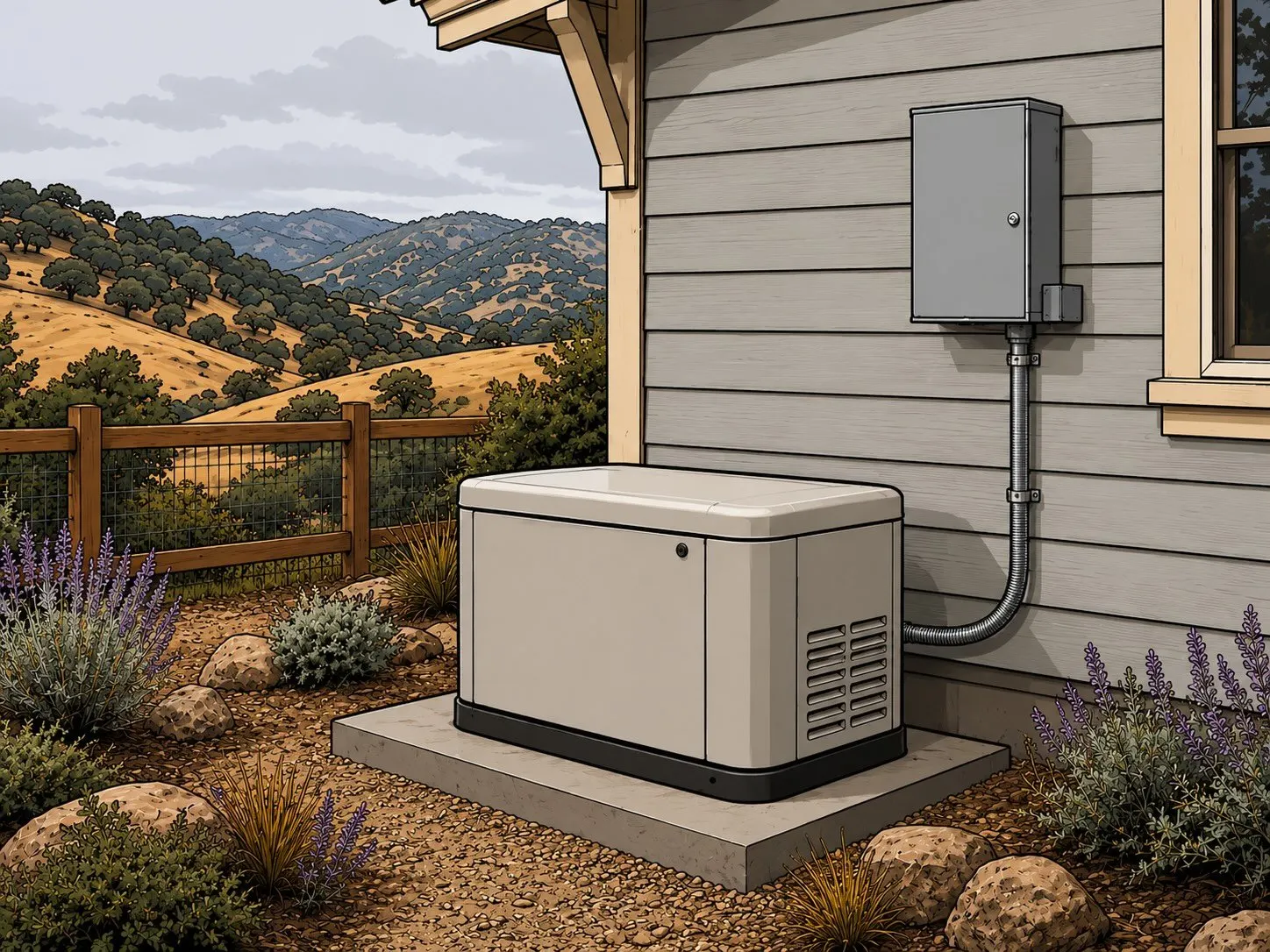
Batteries are completely silent and require no fuel. Generators produce noise comparable to a running lawn mower, which is manageable in rural and semi-rural settings but more disruptive in denser neighborhoods. If your home is already on propane, a propane-fed standby generator is a natural fit with no additional infrastructure needed. If your home is all-electric, generator installation requires a dedicated propane tank, which adds both upfront cost and an ongoing refueling relationship with a propane supplier.
Home Battery vs Generator Lake County CA: Which Option Fits Your Home
When a Home Battery Tends to Be the Better Fit
A home battery tends to make the stronger case in these situations:
- You already have solar or plan to add it
- Most of your outages have been shorter events under 24 hours
- Silence and low maintenance are priorities
- Your neighborhood has limited space or noise constraints that rule out a generator
- You want the system to provide ongoing value by storing off-peak energy or reducing grid dependence on peak-rate afternoons
When a Whole-Home Generator Tends to Be the Better Fit
A whole-home generator tends to make the stronger case when your area has a documented history of multi-day outages, when you need to run high-draw loads like central AC and a well pump at full capacity without trade-offs, or when you do not have solar and are not planning to add it. It is also a strong fit when your home is on natural gas, which enables effectively unlimited runtime as long as gas service remains available, or when seamless full-home coverage at full consumption is your non-negotiable priority.
When It Makes Sense to Have Both
Some Lake County homeowners install both systems, using a home battery for day-to-day outage coverage and short PSPS events while retaining a generator for extended emergencies. This combination provides the cleanest solution for short events, with the capacity to handle whatever duration an extended wildfire-related outage demands. For households where medical equipment, a well pump serving a working property, or other mission-critical systems make power loss a serious risk, the redundancy is worth serious consideration.
For example, a Kelseyville homeowner with a well pump and a family member on home oxygen might pair a 20 kWh battery for seamless short outages with a propane generator for the multi-day events that hit that area in 2022 and 2023.
The Right Installer Makes the Difference
Why Local Experience Matters in Lake County
Specifying, sizing, and installing backup power systems in Lake County requires more than following a manufacturer’s guide.
Lot sizes vary dramatically across the county. Setback requirements for generators differ by jurisdiction. Propane tank placement needs to account for fire risk, access, and aesthetic constraints.
Battery installations in older Lake County homes sometimes surface electrical panel upgrade needs that affect the overall project scope and cost.
Jonas Energy has been installing systems in this area since 2000. The team has direct experience with which neighborhoods see the longest outages, how local utilities handle restoration sequencing, and what installation challenges come up most often in different parts of Lake County. That local context shapes every recommendation Jonas Energy makes, and it is the difference between a system sized on paper and a system sized for how power actually behaves where you live.
What to Ask Before You Commit to Either System
Before committing to a battery or a generator, it is worth asking a few direct questions.
How long are typical outages in your specific neighborhood? What loads do you actually need to power, and for how long? Does your current electrical panel support the installation, or will an upgrade be needed?
If you already have solar, how does that change battery sizing? Is your property zoned and sized appropriately for a standby generator, and what are the local setback requirements?
Jonas Energy walks through all of these questions before recommending a system. The goal is to match the solution to your home and your actual outage history, not to default to the most expensive option. If you want an honest conversation about which backup power approach makes sense for your situation in Lake County, contact Jonas Energy Solutions or call (707) 994-5911 today.