
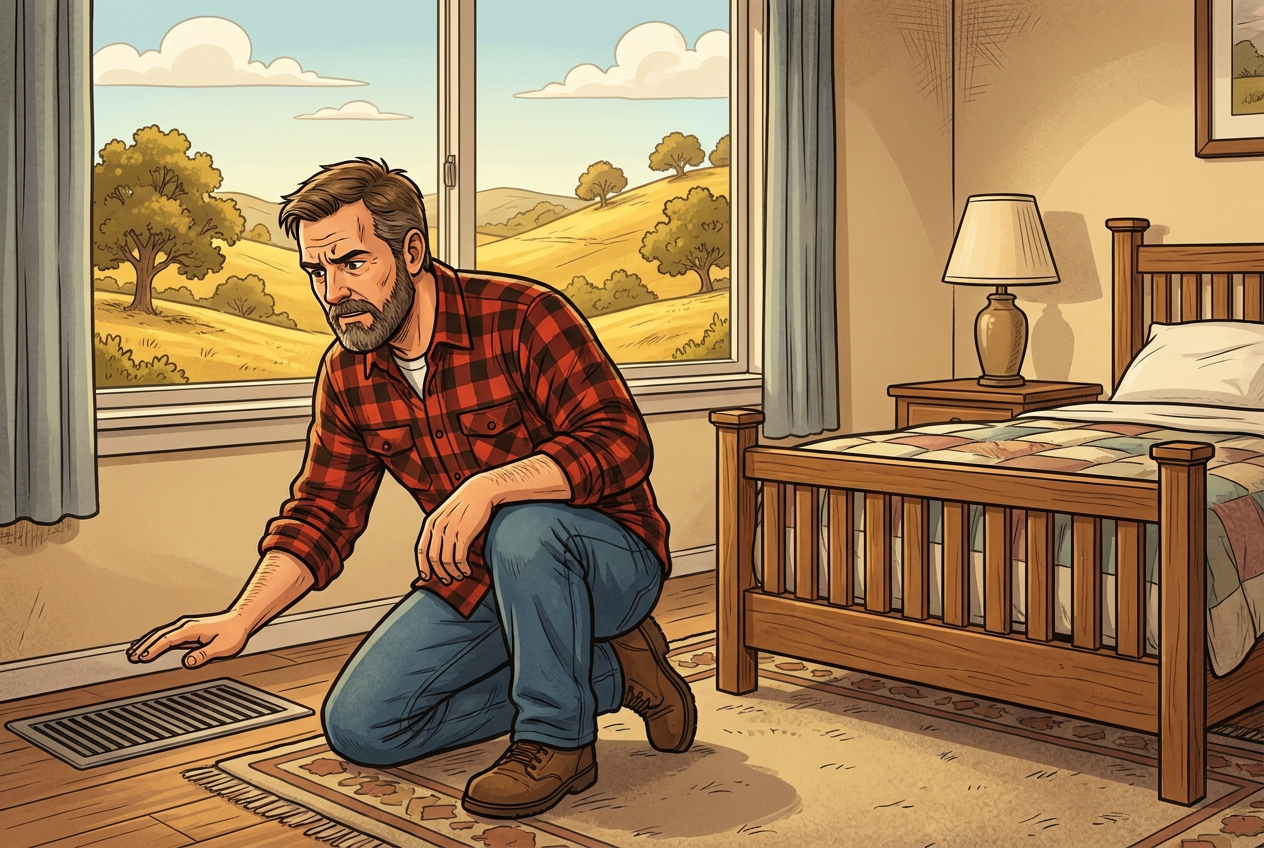
Before you drag a space heater into that perpetually cold bedroom or back office, a quick DIY comfort audit can reveal whether the real culprit is a blocked vent, a leaky duct, or an aging furnace that no space heater will ever fix. In Lake County and El Dorado County homes, older housing stock and long duct runs are the norm. A single cold room is almost always a symptom of something deeper. Spending fifteen minutes with this guide could save you the cost of a space heater you don't need, and point you toward a fix that actually lasts.
Why One Room Stays Cold While the Rest of the House Feels Fine
When one room is always cold, the cause is almost never the thermostat setting. It usually points to restricted airflow, duct problems, poor insulation, or a heating system that is undersized or worn out. All of which a space heater will mask but never solve. Understanding the actual cause matters because each fix is different: a blocked vent takes five minutes to clear, a duct disconnection requires a professional repair, and a failing furnace may need replacement. Treating the symptom without knowing the source just delays the real answer and keeps your energy bills higher than they need to be.
Foothill homes in communities like Placerville, Kelseyville, and Hidden Valley Lake often have duct systems that run long distances through unconditioned attics or crawlspaces. That physical reality makes them especially prone to the problems this audit is designed to find. Most of the early checks require no tools at all. Just your hands, your eyes, and a few minutes of focused attention. If you want to learn more about heating services for Lake County and El Dorado County homeowners, that context is useful before you start so you know what a professional evaluation covers once you've exhausted the DIY steps.
Step One: Check the Obvious Airflow Blockers First
Vents, Registers, and Furniture Placement
Start at the supply register in the cold room. Is it fully open? It sounds obvious, but registers are easy to close accidentally. Especially in rooms that aren't used daily. Kneel down and hold your hand a few inches above the grille when the system is running. You should feel a clear, steady flow of warm air. Weak flow or no flow at all is your first real clue.
Furniture placement is the second thing to check. A bed frame sitting directly over a floor register, or a bookcase pushed against a wall register, can redirect or block conditioned air entirely. The room may have been perfectly comfortable before the furniture was rearranged. The fix is as simple as moving a piece of furniture six inches.
Air Filter Condition and Return-Air Restrictions
A clogged air filter is one of the most common reasons airflow weakens across the whole system, but the cold room at the end of a long duct run always feels it first. Pull the filter and hold it up to light. If you can't see light through it, replace it before moving on. A clean filter takes about two minutes to swap and can meaningfully change how much air reaches distant rooms.
Return-air grilles deserve a look too. These are the larger grilles, usually in hallways or central areas, that pull air back to the furnace. Blocked by furniture, curtains, or accumulated debris, they make the whole system struggle to circulate properly. Clear them and run the system for a full cycle before drawing any conclusions.
 Duct leaks at joints and connections are one of the most common and most overlooked reasons a room at the end of a long duct run stays cold all winter.
Step Two: Inspect Your Ducts for Leaks and Disconnections
How to Spot a Duct Problem Without Special Tools
Duct leaks are one of the most common reasons a room at the end of a long duct run stays cold. Conditioned air escapes into the attic or crawlspace before it reaches the room, so even a well-functioning furnace cannot compensate. Look for visible gaps, disconnected flex duct, or a dusty ring around supply registers. That ring is a telltale sign that air is leaking out around the duct connection before it exits cleanly through the grille.
If you can safely access your attic or crawlspace, take a flashlight and trace the duct run toward the cold room. Flex duct, the silver accordion-style tubing common in foothill homes, can pull away from collar fittings over time, especially in older installations. A gap of even an inch or two at a joint can dump a significant portion of your heated air into unconditioned space before it ever reaches the room.
Why Duct Leaks Hit the Farthest Rooms Hardest
Air pressure drops as it travels through a duct system. By the time conditioned air reaches a room at the far end of a long run, it has already lost some of its momentum. Any leak along the way compounds that loss. Rooms closest to the furnace or air handler receive air at higher pressure and are less affected. The room that's always cold is often simply the last stop on a compromised route.
- Run the heating system and walk to the cold room's supply register. Hold your hand above it to gauge airflow strength.
- Check the register grille for a dusty ring, which suggests air is leaking out around the duct boot rather than through the grille.
- If attic or crawlspace access is safe, trace the flex duct toward the cold room and look for separated joints or crushed sections.
- Feel along accessible duct sections while the system runs. A noticeable puff of warm air near a seam confirms a leak.
- Note any sections where insulation has slipped off the flex duct, since uninsulated duct in a cold attic loses heat before it arrives.
Duct repairs that are accessible and straightforward, like reconnecting a pulled flex duct at a collar, can sometimes be a DIY fix using proper mastic sealant or metal-backed tape. Anything deeper in the system, or any duct running through a tight crawlspace, is worth having a professional assess. The HVAC services including duct evaluation and repair that a qualified contractor provides go well beyond what's visible from an attic hatch.
Step Three: Assess Insulation and Air Sealing in the Cold Room
Exterior Walls, Windows, and Attic Access Points
A room with good airflow can still feel cold if its envelope is leaking heat to the outside. Older homes in Lake County and El Dorado County frequently have under-insulated exterior walls, single-pane windows, or attic hatches with no insulation backing. Each of those paths bleeds heat out of the room faster than the heating system can replace it.
Pay particular attention to rooms that share an exterior wall with an unheated garage, a crawlspace below, or an attic above. These are the three most common thermal weak points in foothill homes. A corner room with two exterior walls and a large window has a geometry that alone can explain a significant comfort gap compared to interior rooms.
The Hand Test and Other Low-Tech Checks
Hold your hand flat against the interior surface of exterior walls on a cold day. A wall with adequate insulation will feel roughly room temperature. A noticeably cold surface means heat is conducting through the wall assembly. The same test works on window glass and the underside of an attic hatch.
Run your hand slowly around window and door frames, electrical outlets on exterior walls, and any penetrations where pipes or wires enter the room. Drafts are often subtle enough that you won't feel them standing a foot away, but you'll catch them with your hand close to the surface. A stick of incense held near suspected gaps will make even a small draft visible as moving smoke. Low-cost checks that can reveal a lot before you spend anything.
 When vents and ducts check out but a room is still cold, the furnace or heat pump itself may be the source of the problem, especially in systems more than 15 years old.
When the Audit Points to Your Furnace or Heat Pump
If your vents are clear, ducts are intact, and insulation seems adequate but the room is still cold, the heating system itself may be undersized, overdue for maintenance, or failing. Furnaces and heat pumps that are more than 15 years old often lose enough capacity that the farthest or most exposed rooms suffer first. The system may still heat the core of the house adequately while simply running out of output before it reaches the edges.
A few signs that the equipment itself is the limiting factor: the system runs almost continuously on cold days without ever fully warming the house, output air at registers feels noticeably cooler than it used to, or you've noticed the system short-cycling. Turning on and off in rapid bursts rather than completing full heating cycles. Any of these behaviors warrants a professional look before you invest in anything else.
Staying current on HVAC maintenance plans to keep your furnace and heat pump running efficiently is one of the most practical ways to catch declining performance before it becomes a breakdown. A technician checking heat exchanger condition, refrigerant charge, and airflow calibration annually can identify capacity losses that aren't obvious until the coldest nights of the year. For homeowners who want to go deeper on what deterioration looks like in older systems, the heat pump service guides for foothill homeowners cover common failure patterns in plain language.
- System runs nearly continuously on cold days without reaching the set temperature
- Supply air at registers feels cooler than it did in previous winters
- Short-cycling: the system turns on, runs briefly, shuts off, and repeats without completing a full heating cycle
- Unusual sounds from the furnace or air handler. Grinding, rattling, or persistent clicking at startup
- Noticeably higher utility bills without a change in usage habits or outdoor temperatures
When a Ductless Mini-Split Is the Right Long-Term Fix
Sometimes the audit reveals that the cold room is genuinely difficult to serve with the existing duct system. A room added during a renovation, a converted garage, or a detached bonus space may never get adequate heat through ducts that weren't designed to reach it. That's not a failure of the furnace or the ducts. It's a design limitation.
A ductless mini-split installed in that room gives it its own dedicated heating and cooling source, completely independent of the central system. Quiet, efficient, and precise. You set the temperature for that room without affecting the rest of the house. For rooms with chronic comfort problems that can't be traced to a single fixable cause, a mini-split is often the most cost-effective permanent solution.
The upfront cost is higher than a space heater, but a mini-split is a permanent, code-compliant installation that adds real value rather than a workaround that runs up your electric bill. Financing options for ductless mini-split installation are worth exploring if the investment feels like a stretch. Spreading the cost over time often makes the math more comfortable than the sticker price suggests.
Can I fix a duct leak myself, or do I need a professional?
Simple, accessible duct disconnections, like a flex duct that has pulled away from a collar fitting in an open attic, can sometimes be reattached and sealed by a careful homeowner using mastic sealant or metal-backed foil tape (not standard duct tape, which fails quickly). Anything deeper in the system, in a tight crawlspace, or involving rigid ductwork is better left to a professional who can pressure-test the system and confirm the repair is complete.
How do I know if my furnace is undersized for my home?
A furnace that runs almost continuously on cold days without reaching the thermostat set point, or that keeps most of the house comfortable but consistently leaves one or two rooms cold, may be undersized. An HVAC technician can perform a load calculation to determine whether the equipment matches the home's actual heating demand. This step is especially useful in older homes that have been added onto or re-insulated since the original system was installed.
Is a space heater ever the right answer?
A space heater makes sense as a short-term measure while you investigate and plan a real fix, or for a room you use only occasionally where running the full central system doesn't make sense. It is not a cost-effective long-term solution for a room that should be served by the central system. The operating cost of an electric space heater used daily will typically exceed the cost of a proper repair over a single heating season.
What's the first thing a technician checks when one room is always cold?
A technician will typically start with airflow measurements at the supply register in the cold room, then compare them to design specifications for the duct run. From there they'll check filter condition, duct integrity, and equipment output. In many cases the problem is identified within the first thirty minutes of an evaluation. The diagnostic process is straightforward when you know what to measure.